🧠 Key takeaways
Unpaired, reference and mosaic integration combine modalities that were not measured in the same cells, and GLUE is the most accurate method for unpaired RNA and ATAC data.
Multimodal references let unimodal queries borrow the missing modality, but imputed values are only reliable for well-measured features.
MultiVI integrates datasets that share only some modalities, and results should be checked against held-out measurements.
⚙️ Environment setup
Install conda:
Before creating the environment, ensure that conda is installed on your system.
Save the yml content:
Copy the content from the yml tab into a file named
environment.yml.
Create the environment:
Open a terminal or command prompt.
Run the following command:
conda env create -f environment.yml
Activate the environment:
After the environment is created, activate it using:
conda activate <environment_name>Replace
<environment_name>with the name specified in theenvironment.ymlfile. In the yml file it will look like this:name: <environment_name>
Verify the installation:
Check that the environment was created successfully by running:
conda env list
name: multimodal-integration
channels:
  - conda-forge
  - bioconda
dependencies:
  - bioconda::bedtools=2.31.1
  - conda-forge::ipykernel=7.3.0
  - conda-forge::ipywidgets=8.1.9
  - conda-forge::python=3.13.15
  - conda-forge::scanpy=1.12.4
  - pip
  - pip:
      - lamindb==2.10.0
      - mofapy2==0.7.5
      - muon==0.1.9
      - scglue==0.4.1
      - scib-metrics==0.6.1
      - scvi-tools==1.5.1
🗄️ Get data and notebooks
This book uses lamindb to store, share, and load datasets and notebooks using the theislab/sc-best-practices instance. We acknowledge free hosting from Lamin Labs.
Install lamindb
Install the lamindb Python package:
pip install lamindbOptionally create a lamin account
Sign up and log in following the instructions
Verify your setup
Run the
lamin connectcommand:
import lamindb as ln

ln.Artifact.connect("theislab/sc-best-practices").df()
You should now see up to 100 of the stored datasets.
Accessing datasets (Artifacts)
Search for the datasets on the Artifacts page
Load an Artifact and the corresponding object:
import lamindb as ln

af = ln.Artifact.connect("theislab/sc-best-practices").get(
    key="key_of_dataset", is_latest=True
)
obj = af.load()
The object is now accessible in memory and is ready for analysis. Adapt the
lamindb.Artifact.connect("theislab/sc-best-practices").get("SOMEIDXXXX")suffix to get respective versions.Accessing notebooks (Transforms)
Search for the notebook on the Transforms page
Load the notebook:
lamin load <notebook url>which will download the notebook to the current working directory. Analogously to
Artifacts, you can adapt the suffix ID to get older versions.
Motivation
Modalities are often not measured in the same cells. An RNA atlas may need to be combined with chromatin accessibility from other cells, new data may need to be mapped onto an existing multimodal reference, or datasets may share only some of their modalities. These tasks are called unpaired (diagonal) integration, reference mapping and mosaic integration.
In independent benchmarks, GLUE was the most accurate method for unpaired RNA and ATAC data, MultiVI performed well for mosaic integration of RNA and ATAC, and totalVI predicted proteins from RNA best Hu et al., 2024Fu et al., 2025Liu et al., 2025. We use the bone marrow data of the previous chapter and hold out one modality or part of the data, so that each result can be checked against the measurements.
import itertools
import logging
import warnings
from functools import partialmethod
from unittest.mock import patch

warnings.filterwarnings("ignore")
logging.getLogger("jax").setLevel(logging.ERROR)

import anndata as ad
import lamindb as ln
import mudata as md
import numpy as np
import pandas as pd
import scanpy as sc
import scglue
import scipy.sparse as sp
import scvi
from scib_metrics.benchmark import Benchmarker
from scipy.stats import spearmanr
from sklearn.neighbors import KNeighborsClassifier

scvi.settings.seed = 0

ln.connect("theislab/sc-best-practices")

ln.track("MyndPufarKGV")
Output
→ connected lamindb: theislab/sc-best-practices
Seed set to 0
! It looks like you are running jupyter lab but don't have jupyter-server module installed. Please install it via pip install jupyter-server
→ loaded Transform('MyndPufarKGV0000', key='advanced_integration.ipynb'), started new Run('dbS3SoeXLcEuALSi') at 2026-09-30 13:18:55 UTC
→ notebook imports: anndata==0.13.2 lamindb-core==2.10.0 mudata==0.4.1 numpy==2.5.3 pandas==3.0.6 scanpy==1.12.4 scglue==0.4.1 scib-metrics==0.6.1 scikit-learn==1.9.1 scipy==1.18.1 scvi-tools==1.5.1
Unpaired integration with GLUE
Without paired cells, RNA and ATAC share no features, so a method needs prior knowledge to connect them. GLUE links each gene to the peaks near its promoter and gene body in a guidance graph and learns embeddings of the cells of both modalities that respect these links Cao & Gao, 2022. We take the RNA of two Multiome donors and the ATAC of the third donor, so that no cell is measured in both, and use the measured labels only to check the result.
multiome = ln.Artifact.get(
    key="multimodal_integration/neurips2021_multiome.h5mu"
).load()
rna = multiome["rna"][multiome["rna"].obs["batch"].isin(["s1d1", "s1d2"])].copy()
atac = multiome["atac"][multiome["atac"].obs["batch"] == "s1d3"].copy()
rna.n_obs, atac.n_obs
(12964, 4279)GLUE reduces RNA with PCA and ATAC with LSI, reconstructs the raw counts, and needs genomic coordinates for genes and peaks to build the guidance graph.
rna.layers["counts"] = rna.X.copy()
sc.pp.highly_variable_genes(rna, n_top_genes=2000, flavor="seurat_v3")
sc.pp.normalize_total(rna)
sc.pp.log1p(rna)
sc.pp.scale(rna)
sc.pp.pca(rna, n_comps=100)
scglue.data.lsi(atac, n_components=100, n_iter=15)

gtf = ln.Artifact.get(
    key="multimodal_integration/gencode.v41.basic.annotation.gtf.gz"
).cache()
scglue.data.get_gene_annotation(rna, gtf=gtf, gtf_by="gene_name")
rna = rna[:, rna.var["chrom"].notna()].copy()
coordinates = atac.var_names.str.split("-", expand=True)
atac.var["chrom"] = coordinates.get_level_values(0)
atac.var["chromStart"] = coordinates.get_level_values(1).astype(int)
atac.var["chromEnd"] = coordinates.get_level_values(2).astype(int)
guidance = scglue.genomics.rna_anchored_guidance_graph(rna, atac)
Output
scglue.models.configure_dataset(
    rna, "NB", use_highly_variable=True, use_layer="counts", use_rep="X_pca"
)
scglue.models.configure_dataset(atac, "NB", use_highly_variable=True, use_rep="X_lsi")
guidance_hvf = guidance.subgraph(
    itertools.chain(
        rna.var.query("highly_variable").index, atac.var.query("highly_variable").index
    )
).copy()
# scglue writes into read-only pandas 3 arrays (gao-lab/GLUE#140)
with patch.object(pd.Series, "to_numpy", partialmethod(pd.Series.to_numpy, copy=True)):
    glue = scglue.models.fit_SCGLUE({"rna": rna, "atac": atac}, guidance_hvf)
rna.obsm["X_glue"] = glue.encode_data("rna", rna)
atac.obsm["X_glue"] = glue.encode_data("atac", atac)
Output
[INFO] fit_SCGLUE: Pretraining SCGLUE model...
[INFO] autodevice: Using GPU 0 as computation device.
[INFO] check_graph: Checking variable coverage...
[INFO] check_graph: Checking edge attributes...
[INFO] check_graph: Checking self-loops...
[INFO] check_graph: Checking graph symmetry...
[INFO] SCGLUEModel: Setting `graph_batch_size` = 15293
[INFO] SCGLUEModel: Setting `max_epochs` = 198
[INFO] SCGLUEModel: Setting `patience` = 17
[INFO] SCGLUEModel: Setting `reduce_lr_patience` = 9
[INFO] SCGLUETrainer: Using training directory: "/tmp/GLUETMPy0dycagq"
[INFO] SCGLUETrainer: [Epoch 10] train={'g_nll': 0.463, 'g_kl': 0.011, 'g_elbo': 0.475, 'x_rna_nll': 0.3, 'x_rna_kl': 0.01, 'x_rna_elbo': 0.31, 'x_atac_nll': 0.128, 'x_atac_kl': 0.001, 'x_atac_elbo': 0.129, 'dsc_loss': 0.686, 'vae_loss': 0.458, 'gen_loss': 0.424}, val={'g_nll': 0.461, 'g_kl': 0.012, 'g_elbo': 0.473, 'x_rna_nll': 0.301, 'x_rna_kl': 0.01, 'x_rna_elbo': 0.311, 'x_atac_nll': 0.125, 'x_atac_kl': 0.001, 'x_atac_elbo': 0.127, 'dsc_loss': 0.692, 'vae_loss': 0.456, 'gen_loss': 0.421}, 1.6s elapsed
[INFO] SCGLUETrainer: [Epoch 20] train={'g_nll': 0.446, 'g_kl': 0.011, 'g_elbo': 0.457, 'x_rna_nll': 0.294, 'x_rna_kl': 0.01, 'x_rna_elbo': 0.305, 'x_atac_nll': 0.123, 'x_atac_kl': 0.001, 'x_atac_elbo': 0.124, 'dsc_loss': 0.688, 'vae_loss': 0.447, 'gen_loss': 0.412}, val={'g_nll': 0.445, 'g_kl': 0.011, 'g_elbo': 0.457, 'x_rna_nll': 0.296, 'x_rna_kl': 0.01, 'x_rna_elbo': 0.306, 'x_atac_nll': 0.12, 'x_atac_kl': 0.001, 'x_atac_elbo': 0.122, 'dsc_loss': 0.694, 'vae_loss': 0.446, 'gen_loss': 0.411}, 1.7s elapsed
[INFO] SCGLUETrainer: [Epoch 30] train={'g_nll': 0.44, 'g_kl': 0.011, 'g_elbo': 0.451, 'x_rna_nll': 0.293, 'x_rna_kl': 0.01, 'x_rna_elbo': 0.303, 'x_atac_nll': 0.122, 'x_atac_kl': 0.001, 'x_atac_elbo': 0.123, 'dsc_loss': 0.69, 'vae_loss': 0.444, 'gen_loss': 0.41}, val={'g_nll': 0.44, 'g_kl': 0.011, 'g_elbo': 0.451, 'x_rna_nll': 0.297, 'x_rna_kl': 0.01, 'x_rna_elbo': 0.307, 'x_atac_nll': 0.123, 'x_atac_kl': 0.001, 'x_atac_elbo': 0.124, 'dsc_loss': 0.688, 'vae_loss': 0.449, 'gen_loss': 0.414}, 1.5s elapsed
[INFO] LRScheduler: Learning rate reduction: step 1
[INFO] SCGLUETrainer: [Epoch 40] train={'g_nll': 0.439, 'g_kl': 0.011, 'g_elbo': 0.45, 'x_rna_nll': 0.292, 'x_rna_kl': 0.01, 'x_rna_elbo': 0.302, 'x_atac_nll': 0.122, 'x_atac_kl': 0.001, 'x_atac_elbo': 0.123, 'dsc_loss': 0.69, 'vae_loss': 0.443, 'gen_loss': 0.409}, val={'g_nll': 0.439, 'g_kl': 0.011, 'g_elbo': 0.45, 'x_rna_nll': 0.298, 'x_rna_kl': 0.01, 'x_rna_elbo': 0.308, 'x_atac_nll': 0.123, 'x_atac_kl': 0.001, 'x_atac_elbo': 0.124, 'dsc_loss': 0.688, 'vae_loss': 0.45, 'gen_loss': 0.415}, 1.8s elapsed
[INFO] LRScheduler: Learning rate reduction: step 2
[INFO] SCGLUETrainer: [Epoch 50] train={'g_nll': 0.439, 'g_kl': 0.011, 'g_elbo': 0.45, 'x_rna_nll': 0.291, 'x_rna_kl': 0.01, 'x_rna_elbo': 0.301, 'x_atac_nll': 0.122, 'x_atac_kl': 0.001, 'x_atac_elbo': 0.123, 'dsc_loss': 0.689, 'vae_loss': 0.442, 'gen_loss': 0.407}, val={'g_nll': 0.439, 'g_kl': 0.011, 'g_elbo': 0.45, 'x_rna_nll': 0.295, 'x_rna_kl': 0.01, 'x_rna_elbo': 0.305, 'x_atac_nll': 0.121, 'x_atac_kl': 0.001, 'x_atac_elbo': 0.123, 'dsc_loss': 0.687, 'vae_loss': 0.445, 'gen_loss': 0.411}, 1.9s elapsed
2026-09-30 15:21:09,570 ignite.handlers.early_stopping.EarlyStopping INFO: EarlyStopping: Stop training
[INFO] EarlyStopping: Restoring checkpoint "46"...
[INFO] EarlyStopping: Restoring checkpoint "46"...
[INFO] fit_SCGLUE: Estimating balancing weight...
[INFO] estimate_balancing_weight: Clustering cells...
[INFO] estimate_balancing_weight: Matching clusters...
[INFO] estimate_balancing_weight: Matching array shape = (21, 17)...
[INFO] estimate_balancing_weight: Estimating balancing weight...
[INFO] fit_SCGLUE: Fine-tuning SCGLUE model...
[INFO] check_graph: Checking variable coverage...
[INFO] check_graph: Checking edge attributes...
[INFO] check_graph: Checking self-loops...
[INFO] check_graph: Checking graph symmetry...
[INFO] SCGLUEModel: Setting `graph_batch_size` = 15293
[INFO] SCGLUEModel: Setting `align_burnin` = 33
[INFO] SCGLUEModel: Setting `max_epochs` = 198
[INFO] SCGLUEModel: Setting `patience` = 17
[INFO] SCGLUEModel: Setting `reduce_lr_patience` = 9
[INFO] SCGLUETrainer: Using training directory: "/tmp/GLUETMPuzz3i901"
[INFO] SCGLUETrainer: [Epoch 10] train={'g_nll': 0.436, 'g_kl': 0.011, 'g_elbo': 0.446, 'x_rna_nll': 0.294, 'x_rna_kl': 0.01, 'x_rna_elbo': 0.304, 'x_atac_nll': 0.121, 'x_atac_kl': 0.001, 'x_atac_elbo': 0.122, 'dsc_loss': 0.688, 'vae_loss': 0.444, 'gen_loss': 0.409}, val={'g_nll': 0.435, 'g_kl': 0.011, 'g_elbo': 0.445, 'x_rna_nll': 0.291, 'x_rna_kl': 0.01, 'x_rna_elbo': 0.301, 'x_atac_nll': 0.127, 'x_atac_kl': 0.001, 'x_atac_elbo': 0.128, 'dsc_loss': 0.7, 'vae_loss': 0.447, 'gen_loss': 0.412}, 1.8s elapsed
[INFO] SCGLUETrainer: [Epoch 20] train={'g_nll': 0.433, 'g_kl': 0.01, 'g_elbo': 0.444, 'x_rna_nll': 0.293, 'x_rna_kl': 0.01, 'x_rna_elbo': 0.302, 'x_atac_nll': 0.12, 'x_atac_kl': 0.001, 'x_atac_elbo': 0.121, 'dsc_loss': 0.687, 'vae_loss': 0.441, 'gen_loss': 0.407}, val={'g_nll': 0.433, 'g_kl': 0.01, 'g_elbo': 0.444, 'x_rna_nll': 0.288, 'x_rna_kl': 0.01, 'x_rna_elbo': 0.297, 'x_atac_nll': 0.125, 'x_atac_kl': 0.001, 'x_atac_elbo': 0.127, 'dsc_loss': 0.699, 'vae_loss': 0.442, 'gen_loss': 0.407}, 1.6s elapsed
[INFO] SCGLUETrainer: [Epoch 30] train={'g_nll': 0.432, 'g_kl': 0.01, 'g_elbo': 0.442, 'x_rna_nll': 0.293, 'x_rna_kl': 0.01, 'x_rna_elbo': 0.303, 'x_atac_nll': 0.121, 'x_atac_kl': 0.001, 'x_atac_elbo': 0.122, 'dsc_loss': 0.686, 'vae_loss': 0.443, 'gen_loss': 0.409}, val={'g_nll': 0.432, 'g_kl': 0.01, 'g_elbo': 0.442, 'x_rna_nll': 0.288, 'x_rna_kl': 0.01, 'x_rna_elbo': 0.297, 'x_atac_nll': 0.128, 'x_atac_kl': 0.001, 'x_atac_elbo': 0.129, 'dsc_loss': 0.699, 'vae_loss': 0.444, 'gen_loss': 0.409}, 1.7s elapsed
[INFO] SCGLUETrainer: [Epoch 40] train={'g_nll': 0.431, 'g_kl': 0.01, 'g_elbo': 0.44, 'x_rna_nll': 0.292, 'x_rna_kl': 0.01, 'x_rna_elbo': 0.302, 'x_atac_nll': 0.121, 'x_atac_kl': 0.001, 'x_atac_elbo': 0.122, 'dsc_loss': 0.685, 'vae_loss': 0.442, 'gen_loss': 0.407}, val={'g_nll': 0.431, 'g_kl': 0.01, 'g_elbo': 0.441, 'x_rna_nll': 0.288, 'x_rna_kl': 0.01, 'x_rna_elbo': 0.297, 'x_atac_nll': 0.128, 'x_atac_kl': 0.001, 'x_atac_elbo': 0.129, 'dsc_loss': 0.71, 'vae_loss': 0.444, 'gen_loss': 0.408}, 1.6s elapsed
[INFO] SCGLUETrainer: [Epoch 50] train={'g_nll': 0.43, 'g_kl': 0.01, 'g_elbo': 0.439, 'x_rna_nll': 0.293, 'x_rna_kl': 0.01, 'x_rna_elbo': 0.302, 'x_atac_nll': 0.121, 'x_atac_kl': 0.001, 'x_atac_elbo': 0.122, 'dsc_loss': 0.687, 'vae_loss': 0.442, 'gen_loss': 0.407}, val={'g_nll': 0.429, 'g_kl': 0.01, 'g_elbo': 0.439, 'x_rna_nll': 0.285, 'x_rna_kl': 0.009, 'x_rna_elbo': 0.294, 'x_atac_nll': 0.128, 'x_atac_kl': 0.001, 'x_atac_elbo': 0.129, 'dsc_loss': 0.705, 'vae_loss': 0.441, 'gen_loss': 0.405}, 1.6s elapsed
[INFO] LRScheduler: Learning rate reduction: step 1
[INFO] SCGLUETrainer: [Epoch 60] train={'g_nll': 0.428, 'g_kl': 0.01, 'g_elbo': 0.438, 'x_rna_nll': 0.291, 'x_rna_kl': 0.01, 'x_rna_elbo': 0.3, 'x_atac_nll': 0.12, 'x_atac_kl': 0.001, 'x_atac_elbo': 0.121, 'dsc_loss': 0.692, 'vae_loss': 0.439, 'gen_loss': 0.405}, val={'g_nll': 0.428, 'g_kl': 0.01, 'g_elbo': 0.438, 'x_rna_nll': 0.287, 'x_rna_kl': 0.009, 'x_rna_elbo': 0.297, 'x_atac_nll': 0.128, 'x_atac_kl': 0.001, 'x_atac_elbo': 0.129, 'dsc_loss': 0.704, 'vae_loss': 0.443, 'gen_loss': 0.408}, 1.7s elapsed
[INFO] LRScheduler: Learning rate reduction: step 2
[INFO] SCGLUETrainer: [Epoch 70] train={'g_nll': 0.428, 'g_kl': 0.01, 'g_elbo': 0.438, 'x_rna_nll': 0.292, 'x_rna_kl': 0.01, 'x_rna_elbo': 0.301, 'x_atac_nll': 0.12, 'x_atac_kl': 0.001, 'x_atac_elbo': 0.121, 'dsc_loss': 0.689, 'vae_loss': 0.44, 'gen_loss': 0.405}, val={'g_nll': 0.428, 'g_kl': 0.01, 'g_elbo': 0.438, 'x_rna_nll': 0.283, 'x_rna_kl': 0.009, 'x_rna_elbo': 0.293, 'x_atac_nll': 0.128, 'x_atac_kl': 0.001, 'x_atac_elbo': 0.129, 'dsc_loss': 0.7, 'vae_loss': 0.44, 'gen_loss': 0.405}, 1.7s elapsed
[INFO] SCGLUETrainer: [Epoch 80] train={'g_nll': 0.428, 'g_kl': 0.01, 'g_elbo': 0.438, 'x_rna_nll': 0.291, 'x_rna_kl': 0.01, 'x_rna_elbo': 0.3, 'x_atac_nll': 0.121, 'x_atac_kl': 0.001, 'x_atac_elbo': 0.122, 'dsc_loss': 0.691, 'vae_loss': 0.44, 'gen_loss': 0.405}, val={'g_nll': 0.428, 'g_kl': 0.01, 'g_elbo': 0.438, 'x_rna_nll': 0.282, 'x_rna_kl': 0.009, 'x_rna_elbo': 0.292, 'x_atac_nll': 0.123, 'x_atac_kl': 0.001, 'x_atac_elbo': 0.125, 'dsc_loss': 0.699, 'vae_loss': 0.434, 'gen_loss': 0.399}, 1.7s elapsed
[INFO] SCGLUETrainer: [Epoch 90] train={'g_nll': 0.428, 'g_kl': 0.01, 'g_elbo': 0.437, 'x_rna_nll': 0.291, 'x_rna_kl': 0.01, 'x_rna_elbo': 0.3, 'x_atac_nll': 0.122, 'x_atac_kl': 0.001, 'x_atac_elbo': 0.123, 'dsc_loss': 0.69, 'vae_loss': 0.441, 'gen_loss': 0.406}, val={'g_nll': 0.428, 'g_kl': 0.01, 'g_elbo': 0.438, 'x_rna_nll': 0.287, 'x_rna_kl': 0.009, 'x_rna_elbo': 0.296, 'x_atac_nll': 0.128, 'x_atac_kl': 0.001, 'x_atac_elbo': 0.13, 'dsc_loss': 0.701, 'vae_loss': 0.443, 'gen_loss': 0.408}, 1.7s elapsed
[INFO] LRScheduler: Learning rate reduction: step 3
2026-09-30 15:24:22,581 ignite.handlers.early_stopping.EarlyStopping INFO: EarlyStopping: Stop training
[INFO] EarlyStopping: Restoring checkpoint "85"...
[INFO] EarlyStopping: Restoring checkpoint "85"...
combined = ad.concat([rna, atac], label="modality", keys=["RNA", "ATAC"])
sc.pp.neighbors(combined, use_rep="X_glue")
sc.tl.umap(combined)
sc.pl.umap(combined, color=["modality", "cell_type_l1"], wspace=0.4)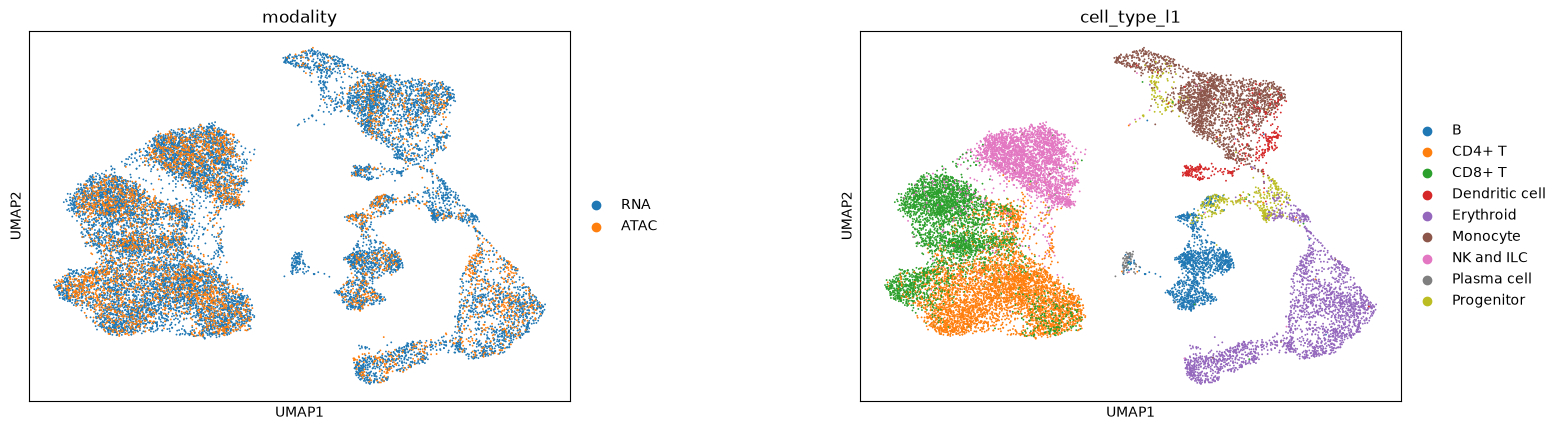
RNA and ATAC cells mix within the lineages, although no cell was measured in both modalities.
A common use of unpaired integration is to annotate ATAC data with an annotated RNA reference. We transfer the labels of the RNA cells to their nearest neighbors among the ATAC cells and compare them with the labels of the ATAC cells.
labels = {}
for level in ("cell_type", "cell_type_l1"):
    knn = KNeighborsClassifier(n_neighbors=15).fit(rna.obsm["X_glue"], rna.obs[level])
    labels[level] = knn.predict(atac.obsm["X_glue"]) == atac.obs[level].to_numpy()
pd.Series({level: correct.mean() for level, correct in labels.items()}, name="accuracy")
cell_type 0.644309
cell_type_l1 0.824959
Name: accuracy, dtype: float6482% of the ATAC cells receive the correct lineage and 64% the correct fine cell type. Most errors occur between closely related T cell states and in rare progenitors, whose differences are small in chromatin accessibility.
Reference mapping with totalVI
A multimodal reference lets us map new data, even of a single modality, onto its embedding and predict the missing modality. totalVI maps a query onto a trained reference by architectural surgery, which fine-tunes only the parameters of the new batches Lotfollahi et al., 2022. We train a totalVI reference on the first three sites of the CITE-seq data and map the fourth site as if only its RNA had been measured.
cite = ln.Artifact.get(key="multimodal_integration/neurips2021_cite.h5mu").load()
rna = cite["rna"].copy()
rna.obsm["protein_counts"] = pd.DataFrame(
    cite["adt"].X.toarray(), index=rna.obs_names, columns=cite["adt"].var_names
)
sc.pp.highly_variable_genes(
    rna, n_top_genes=4000, flavor="seurat_v3", batch_key="batch", subset=True
)
is_query = rna.obs["site"] == "site4"
reference, query = rna[~is_query].copy(), rna[is_query].copy()
measured = query.obsm["protein_counts"].copy()
query.obsm["protein_counts"].loc[:] = 0
reference.n_obs, query.n_obs
(73511, 16750)totalVI treats proteins that are zero in all cells of a batch as missing, so the query only contributes its RNA.
scvi.model.TOTALVI.setup_anndata(
    reference, batch_key="batch", protein_expression_obsm_key="protein_counts"
)
totalvi = scvi.model.TOTALVI(reference, use_observed_lib_size=False)
totalvi.train()
totalvi_query = scvi.model.TOTALVI.load_query_data(query, totalvi)
totalvi_query.train(max_epochs=200, plan_kwargs={"weight_decay": 0.0})
reference.obsm["X_totalVI"] = totalvi.get_latent_representation()
query.obsm["X_totalVI"] = totalvi_query.get_latent_representation()
Output
INFO Using column names from columns of adata.obsm['protein_counts']
INFO Computing empirical prior initialization for protein background.
GPU available: True (cuda), used: True
TPU available: False, using: 0 TPU cores
💡 Tip: For seamless cloud logging and experiment tracking, try installing [litlogger](https://pypi.org/project/litlogger/) to enable LitLogger, which logs metrics and artifacts automatically to the Lightning Experiments platform.
You are using a CUDA device ('NVIDIA RTX PRO 6000 Blackwell Workstation Edition') that has Tensor Cores. To properly utilize them, you should set `torch.set_float32_matmul_precision('medium' | 'high')` which will trade-off precision for performance. For more details, read https://pytorch.org/docs/stable/generated/torch.set_float32_matmul_precision.html#torch.set_float32_matmul_precision
LOCAL_RANK: 0 - CUDA_VISIBLE_DEVICES: [0]
`Trainer.fit` stopped: `max_epochs=109` reached.
INFO Found batches with missing protein expression
INFO Computing empirical prior initialization for protein background.
GPU available: True (cuda), used: True
TPU available: False, using: 0 TPU cores
💡 Tip: For seamless cloud logging and experiment tracking, try installing [litlogger](https://pypi.org/project/litlogger/) to enable LitLogger, which logs metrics and artifacts automatically to the Lightning Experiments platform.
LOCAL_RANK: 0 - CUDA_VISIBLE_DEVICES: [0]
`Trainer.fit` stopped: `max_epochs=200` reached.
We predict the protein abundances of the query from its RNA and compare them with the held-out measurements.
_, imputed = totalvi_query.get_normalized_expression(
    query, n_samples=25, return_mean=True
)
correlation = pd.Series(
    {
        protein: spearmanr(imputed[protein], measured[protein]).statistic
        for protein in measured
    },
    name="Spearman correlation",
).sort_values()
correlation.describe()
count 134.000000
mean 0.350262
std 0.174187
min -0.149701
25% 0.202560
50% 0.344847
75% 0.483299
max 0.750580
Name: Spearman correlation, dtype: float64pd.concat([correlation.head(5), correlation.tail(5)])PROT_CD274 -0.149701
PROT_TCRVd2 0.031028
PROT_CD23 0.054187
PROT_CD83 0.063094
PROT_CD45 0.072993
PROT_CD226 0.673451
PROT_CD35 0.700162
PROT_CD3 0.719574
PROT_CD5 0.733126
PROT_CD7 0.750580
Name: Spearman correlation, dtype: float64The imputed proteins correlate with the held-out measurements with a median Spearman correlation of 0.34. Lineage markers such as CD3, CD5 and CD7 are predicted well, whereas proteins that are rare or poorly reflected in the RNA, such as PD-L1 (CD274) and the γδ T cell receptor chain TCRVd2, are not. Imputed values should therefore only be used for proteins whose prediction has been validated.
knn = KNeighborsClassifier(n_neighbors=15).fit(
    reference.obsm["X_totalVI"], reference.obs["cell_type"]
)
predicted = knn.predict(query.obsm["X_totalVI"])
(predicted == query.obs["cell_type"].to_numpy()).mean()np.float64(0.6707462686567164)67% of the query cells receive the correct label among the 45 fine cell types of the reference.
Mosaic integration with MultiVI
In mosaic integration, datasets share only some modalities. MultiVI embeds cells with any combination of RNA, chromatin accessibility and proteins, using the modalities that were measured in each cell Ashuach et al., 2023. We integrate the CITE-seq cells of the first site with the Multiome cells of the second site, which share only their RNA.
cite = cite[cite["rna"].obs["site"] == "site1"].copy()
multiome = multiome[multiome["rna"].obs["site"] == "site2"].copy()
genes = cite["rna"].var_names.intersection(multiome["rna"].var_names)
rna = ad.concat(
    [cite["rna"][:, genes], multiome["rna"][:, genes]],
    label="dataset",
    keys=["CITE-seq", "Multiome"],
)
sc.pp.highly_variable_genes(
    rna, n_top_genes=4000, flavor="seurat_v3", batch_key="batch", subset=True
)
atac = multiome["atac"][
    :, np.asarray((multiome["atac"].X > 0).mean(axis=0)).ravel() > 0.05
]
Cells without a modality get zero counts for it, which MultiVI interprets as missing.
def fill_missing(adata: ad.AnnData, obs_names: pd.Index) -> ad.AnnData:
    missing = obs_names.difference(adata.obs_names)
    empty = ad.AnnData(
        sp.csr_matrix((len(missing), adata.n_vars)),
        obs=pd.DataFrame(index=missing),
        var=adata.var,
    )
    return ad.concat([adata, empty], merge="first")[obs_names].copy()


mosaic = md.MuData(
    {
        "rna": rna,
        "atac": fill_missing(atac, rna.obs_names),
        "adt": fill_missing(cite["adt"], rna.obs_names),
    }
)
mosaic.obs[["batch", "dataset", "cell_type_l1"]] = rna.obs[
    ["batch", "dataset", "cell_type_l1"]
]
mosaic
MuData object with n_obs × n_vars = 31537 × 17209
obs: 'batch', 'dataset', 'cell_type_l1'
3 modalities
rna: 31537 × 4000
obs: 'cell_type', 'batch', 'site', 'donor', 'cell_type_l1', 'dataset'
var: 'highly_variable', 'highly_variable_rank', 'means', 'variances', 'variances_norm', 'highly_variable_nbatches'
uns: 'hvg'
layers: None
atac: 31537 × 13075
layers: None
adt: 31537 × 134
layers: Nonescvi.model.MULTIVI.setup_mudata(
mosaic,
batch_key="batch",
modalities={
"rna_layer": "rna",
"atac_layer": "atac",
"protein_layer": "adt",
"batch_key": "rna",
},
)
multivi = scvi.model.MULTIVI(
mosaic, n_genes=mosaic["rna"].n_vars, n_regions=mosaic["atac"].n_vars
)
multivi.train()
rna.obsm["X_multiVI"] = multivi.get_latent_representation()Output
INFO Found batches with missing protein expression
GPU available: True (cuda), used: True
TPU available: False, using: 0 TPU cores
💡 Tip: For seamless cloud logging and experiment tracking, try installing [litlogger](https://pypi.org/project/litlogger/) to enable LitLogger, which logs metrics and artifacts automatically to the Lightning Experiments platform.
LOCAL_RANK: 0 - CUDA_VISIBLE_DEVICES: [0]
Monitored metric reconstruction_loss_validation did not improve in the last 50 records. Best score: 3780.102. Signaling Trainer to stop.
sc.pp.neighbors(rna, use_rep="X_multiVI")
sc.tl.umap(rna)
sc.pl.umap(rna, color=["dataset", "cell_type_l1"], wspace=0.4)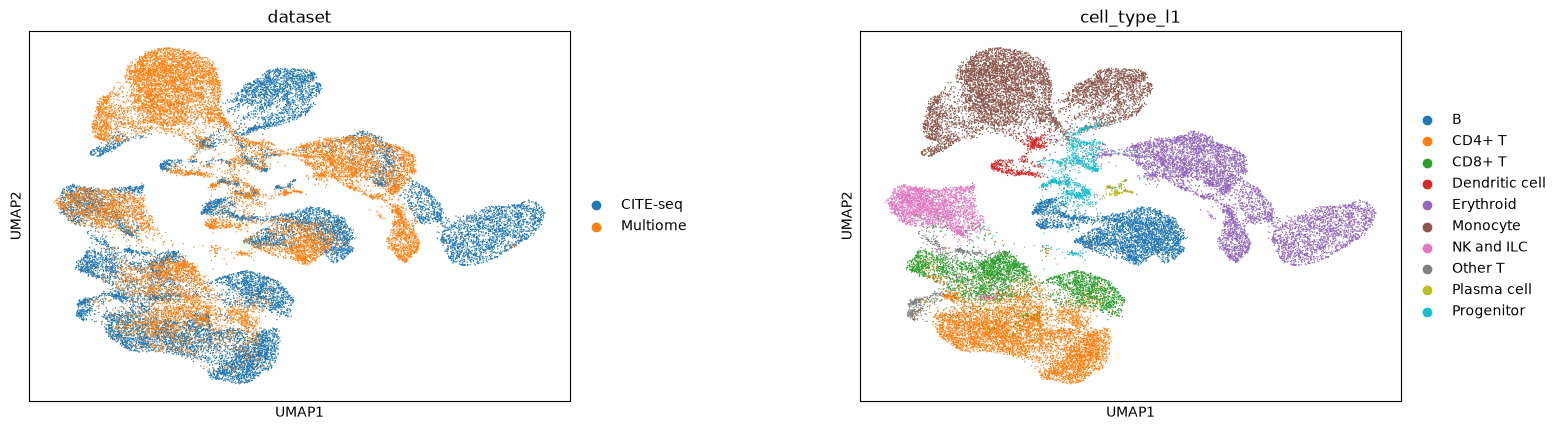
Lymphocytes of both datasets mix within their lineages, whereas monocytes and erythroid cells remain partly separated by dataset, which may reflect differences between the sites as well as between the assays.
sc.pp.pca(rna, n_comps=30)
benchmark = Benchmarker(
    rna,
    batch_key="dataset",
    label_key="cell_type_l1",
    embedding_obsm_keys=["X_pca", "X_multiVI"],
    pre_integrated_embedding_obsm_key="X_pca",
)
benchmark.benchmark()
Output
Computing neighbors: 0%| | 0/2 [00:00<?, ?it/s]Computing neighbors: 50%|█████ | 1/2 [00:10<00:10, 10.45s/it]Computing neighbors: 100%|██████████| 2/2 [00:19<00:00, 9.57s/it]Computing neighbors: 100%|██████████| 2/2 [00:19<00:00, 9.71s/it]
Embeddings: 0%| | 0/2 [00:00<?, ?it/s]
Metrics: 0%| | 0/11 [00:00<?, ?it/s]
Metrics: 0%| | 0/11 [00:00<?, ?it/s, Bio conservation: isolated_labels]
Metrics: 9%|▉ | 1/11 [00:02<00:27, 2.74s/it, Bio conservation: isolated_labels]
Metrics: 9%|▉ | 1/11 [00:03<00:27, 2.74s/it, Bio conservation: nmi_ari_cluster_labels_kmeans]
Metrics: 18%|█▊ | 2/11 [00:06<00:29, 3.26s/it, Bio conservation: nmi_ari_cluster_labels_kmeans]
Metrics: 18%|█▊ | 2/11 [00:06<00:29, 3.26s/it, Bio conservation: silhouette_label]
Metrics: 27%|██▋ | 3/11 [00:08<00:22, 2.86s/it, Bio conservation: silhouette_label]
Metrics: 27%|██▋ | 3/11 [00:09<00:22, 2.86s/it, Bio conservation: clisi_knn]
Metrics: 36%|███▋ | 4/11 [00:09<00:15, 2.16s/it, Bio conservation: clisi_knn]
Metrics: 36%|███▋ | 4/11 [00:10<00:15, 2.16s/it, Batch correction: bras]
Metrics: 45%|████▌ | 5/11 [00:14<00:17, 2.90s/it, Batch correction: bras]
Metrics: 45%|████▌ | 5/11 [00:14<00:17, 2.90s/it, Batch correction: ilisi_knn]
Metrics: 55%|█████▍ | 6/11 [00:14<00:10, 2.18s/it, Batch correction: ilisi_knn]
Metrics: 55%|█████▍ | 6/11 [00:15<00:10, 2.18s/it, Batch correction: kbet_per_label]INFO Other T consists of a single batch or is too small. Skip.
Metrics: 64%|██████▎ | 7/11 [00:29<00:25, 6.37s/it, Batch correction: kbet_per_label]
Metrics: 64%|██████▎ | 7/11 [00:30<00:25, 6.37s/it, Batch correction: graph_connectivity]
Metrics: 73%|███████▎ | 8/11 [00:30<00:13, 4.54s/it, Batch correction: graph_connectivity]
Metrics: 73%|███████▎ | 8/11 [00:31<00:13, 4.54s/it, Batch correction: pcr_comparison]
Metrics: 82%|████████▏ | 9/11 [00:31<00:06, 3.39s/it, Batch correction: pcr_comparison]Embeddings: 50%|█████ | 1/2 [00:31<00:31, 31.91s/it]
Metrics: 0%| | 0/11 [00:00<?, ?it/s]
Metrics: 0%| | 0/11 [00:00<?, ?it/s, Bio conservation: isolated_labels]
Metrics: 9%|▉ | 1/11 [00:01<00:15, 1.54s/it, Bio conservation: isolated_labels]
Metrics: 9%|▉ | 1/11 [00:02<00:15, 1.54s/it, Bio conservation: nmi_ari_cluster_labels_kmeans]
Metrics: 18%|█▊ | 2/11 [00:03<00:18, 2.00s/it, Bio conservation: nmi_ari_cluster_labels_kmeans]
Metrics: 18%|█▊ | 2/11 [00:04<00:18, 2.00s/it, Bio conservation: silhouette_label]
Metrics: 27%|██▋ | 3/11 [00:05<00:14, 1.79s/it, Bio conservation: silhouette_label]
Metrics: 27%|██▋ | 3/11 [00:06<00:14, 1.79s/it, Bio conservation: clisi_knn]
Metrics: 36%|███▋ | 4/11 [00:06<00:09, 1.36s/it, Bio conservation: clisi_knn]
Metrics: 36%|███▋ | 4/11 [00:06<00:09, 1.36s/it, Batch correction: bras]
Metrics: 45%|████▌ | 5/11 [00:07<00:07, 1.29s/it, Batch correction: bras]
Metrics: 45%|████▌ | 5/11 [00:07<00:07, 1.29s/it, Batch correction: ilisi_knn]
Metrics: 55%|█████▍ | 6/11 [00:07<00:05, 1.09s/it, Batch correction: ilisi_knn]
Metrics: 55%|█████▍ | 6/11 [00:08<00:05, 1.09s/it, Batch correction: kbet_per_label]INFO Other T consists of a single batch or is too small. Skip.
Metrics: 64%|██████▎ | 7/11 [00:24<00:24, 6.14s/it, Batch correction: kbet_per_label]
Metrics: 64%|██████▎ | 7/11 [00:25<00:24, 6.14s/it, Batch correction: graph_connectivity]
Metrics: 73%|███████▎ | 8/11 [00:25<00:13, 4.39s/it, Batch correction: graph_connectivity]
Metrics: 73%|███████▎ | 8/11 [00:25<00:13, 4.39s/it, Batch correction: pcr_comparison]
Metrics: 82%|████████▏ | 9/11 [00:25<00:06, 3.26s/it, Batch correction: pcr_comparison]Embeddings: 100%|██████████| 2/2 [00:58<00:00, 28.76s/it]Embeddings: 100%|██████████| 2/2 [00:58<00:00, 29.23s/it]
_ = benchmark.plot_results_table(min_max_scale=False)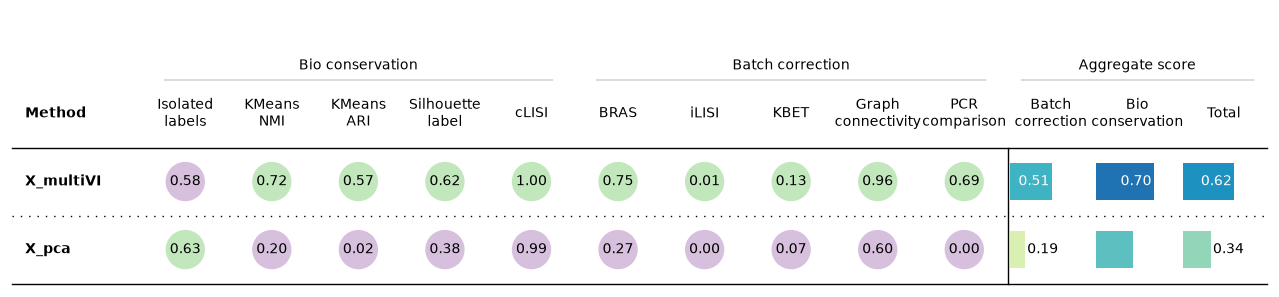
MultiVI improves cell type conservation and batch mixing over the PCA of the shared genes, but the low iLISI and kBET scores confirm that the datasets are not fully mixed. Mosaic integrations therefore have to be checked against known cell types or held-out modalities before the joint embedding is used for downstream analyses.
Further methods
Seurat’s bridge integration maps unimodal queries onto a reference through a multimodal bridge dataset and was among the best methods for transferring labels from RNA to ATAC data Hao et al., 2024Wang & Zhao, 2026, but it is only available in R. For mosaic data of RNA and proteins, MIDAS and StabMap performed best in benchmarks, and MIDAS imputed missing modalities most accurately He et al., 2024Ghazanfar et al., 2024Fu et al., 2025. As in any integration, the results should be checked against known cell types and the measured modalities, as we did above.
Contributors
We gratefully acknowledge the contributions of:
Authors
Anastasia Litinetskaya
Reviewers
Lukas Heumos
- Hu, Y., Wan, S., Luo, Y., Li, Y., Wu, T., Deng, W., Jiang, C., Jiang, S., Zhang, Y., Liu, N., Yang, Z., Chen, F., Li, B., & Qu, K. (2024). Benchmarking algorithms for single-cell multi-omics prediction and integration. Nature Methods, 21(11), 2182–2194. 10.1038/s41592-024-02429-w
- Fu, S., Wang, S., Si, D., Li, G., Gao, Y., & Liu, Q. (2025). Benchmarking single-cell multi-modal data integrations. Nature Methods, 22(11), 2437–2448. 10.1038/s41592-025-02737-9
- Liu, C., Ding, S., Kim, H. J., Long, S., Xiao, D., Ghazanfar, S., & Yang, P. (2025). Multitask benchmarking of single-cell multimodal omics integration methods. Nature Methods, 22(11), 2449–2460. 10.1038/s41592-025-02856-3
- Cao, Z.-J., & Gao, G. (2022). Multi-omics single-cell data integration and regulatory inference with graph-linked embedding. Nature Biotechnology, 40(10), 1458–1466. 10.1038/s41587-022-01284-4
- Lotfollahi, M., Naghipourfar, M., Luecken, M. D., Khajavi, M., Büttner, M., Wagenstetter, M., Avsec, Ž., Gayoso, A., Yosef, N., Interlandi, M., Rybakov, S., Misharin, A. V., & Theis, F. J. (2022). Mapping single-cell data to reference atlases by transfer learning. Nature Biotechnology, 40(1), 121–130. 10.1038/s41587-021-01001-7
- Ashuach, T., Gabitto, M. I., Koodli, R. V., Saldi, G.-A., Jordan, M. I., & Yosef, N. (2023). MultiVI: deep generative model for the integration of multimodal data. Nature Methods, 20(8), 1222–1231. 10.1038/s41592-023-01909-9
- Hao, Y., Stuart, T., Kowalski, M. H., Choudhary, S., Hoffman, P., Hartman, A., Srivastava, A., Molla, G., Madad, S., Fernandez-Granda, C., & Satija, R. (2024). Dictionary learning for integrative, multimodal and scalable single-cell analysis. Nature Biotechnology, 42(2), 293–304. 10.1038/s41587-023-01767-y
- Wang, Y., & Zhao, H. (2026). A comprehensive benchmarking study on computational tools for cross-omics label transfer from single-cell RNA to ATAC data. G3: Genes, Genomes, Genetics, 16(4), jkag026. 10.1093/g3journal/jkag026
- He, Z., Hu, S., Chen, Y., An, S., Zhou, J., Liu, R., Shi, J., Wang, J., Dong, G., Shi, J., Zhao, J., Ou-Yang, L., Zhu, Y., Bo, X., & Ying, X. (2024). Mosaic integration and knowledge transfer of single-cell multimodal data with MIDAS. Nature Biotechnology, 42(10), 1594–1605. 10.1038/s41587-023-02040-y
- Ghazanfar, S., Guibentif, C., & Marioni, J. C. (2024). Stabilized mosaic single-cell data integration using unshared features. Nature Biotechnology, 42(2), 284–292. 10.1038/s41587-023-01766-z