🧠 Key takeaways
T and B cells recognize antigens with receptors whose diversity arises from V(D)J recombination, and the CDR3 at the junction of the gene segments is their most diverse part.
Droplet-based V(D)J libraries are assembled with Cell Ranger, and BCRs should be re-annotated with IgBLAST to reconstruct germline sequences.
Cells with more than two chains of a type or with both TCR and BCR chains are likely doublets, and the receptor type should agree with the transcriptomic cell type.
⚙️ Environment setup
Install conda:
Before creating the environment, ensure that conda is installed on your system.
Save the yml content:
Copy the content from the yml tab into a file named
environment.yml.
Create the environment:
Open a terminal or command prompt.
Run the following command:
conda env create -f environment.yml
Activate the environment:
After the environment is created, activate it using:
conda activate <environment_name>Replace
<environment_name>with the name specified in theenvironment.ymlfile. In the yml file it will look like this:name: <environment_name>
Verify the installation:
Check that the environment was created successfully by running:
conda env list
name: air-repertoire
channels:
  - conda-forge
dependencies:
  - conda-forge::ipykernel=7.3.0
  - conda-forge::ipywidgets=8.1.9
  - conda-forge::python=3.13.15
  - conda-forge::scanpy=1.12.4
  - pip
  - pip:
      - lamindb==2.10.0
      - mudata==0.4.1
      - scirpy==0.25.1
🗄️ Get data and notebooks
This book uses lamindb to store, share, and load datasets and notebooks using the theislab/sc-best-practices instance. We acknowledge free hosting from Lamin Labs.
Install lamindb
Install the lamindb Python package:
pip install lamindbOptionally create a lamin account
Sign up and log in following the instructions
Verify your setup
Run the
lamin connectcommand:
import lamindb as ln

ln.Artifact.connect("theislab/sc-best-practices").df()
You should now see up to 100 of the stored datasets.
Accessing datasets (Artifacts)
Search for the datasets on the Artifacts page
Load an Artifact and the corresponding object:
import lamindb as ln

af = ln.Artifact.connect("theislab/sc-best-practices").get(
    key="key_of_dataset", is_latest=True
)
obj = af.load()
The object is now accessible in memory and is ready for analysis. Adapt the
lamindb.Artifact.connect("theislab/sc-best-practices").get("SOMEIDXXXX")suffix to get respective versions.Accessing notebooks (Transforms)
Search for the notebook on the Transforms page
Load the notebook:
lamin load <notebook url>which will download the notebook to the current working directory. Analogously to
Artifacts, you can adapt the suffix ID to get older versions.
Adaptive immune receptors
T and B cells recognize antigens with their adaptive immune receptors (AIRs), the T cell receptor (TCR) and the B cell receptor (BCR) Cooper & Alder, 2006. TCRs bind peptides presented by major histocompatibility complex (MHC) molecules, whereas BCRs bind antigens directly and are secreted as antibodies by plasma cells. Both receptors consist of two chains, an α and a β or a γ and a δ chain for TCRs and a heavy and a κ or λ light chain for BCRs. We refer to the α, γ, κ and λ chains as VJ chains and to the β, δ and heavy chains as VDJ chains, after the gene segments that encode them.
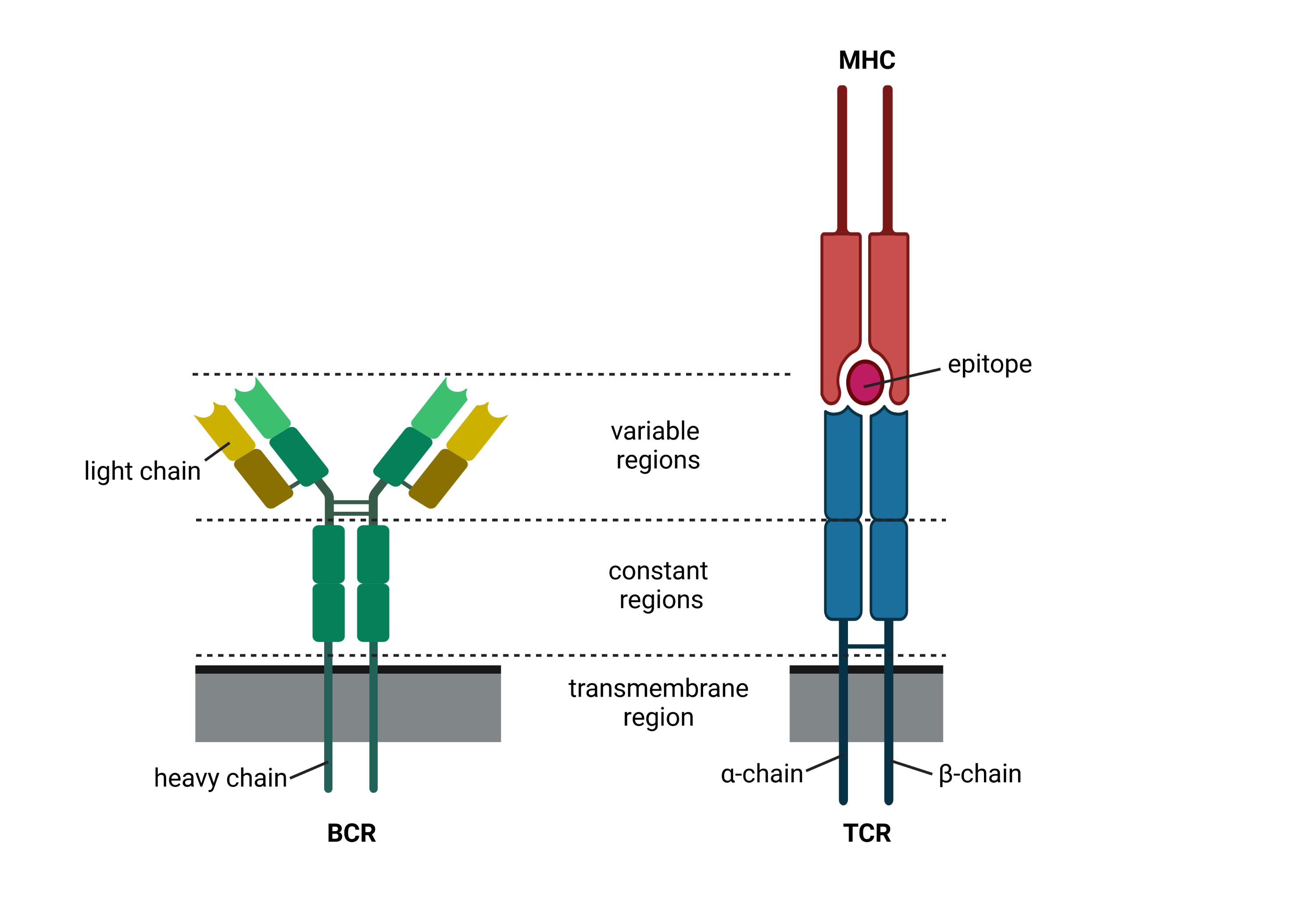
Figure 1:Schematic drawing of the two AIR types. Created with BioRender.com.
Each developing lymphocyte assembles its receptor chains by V(D)J recombination of one V, (D) and J gene segment and inserts or deletes nucleotides where they join. This allows for about 1020 different TCRs, of which a human carries 107 to 108 Zarnitsyna et al., 2013Qi et al., 2014. The third complementarity-determining region (CDR3) spans these junctions and is therefore the most diverse part of each chain and its main contact with the antigen, whereas CDR1 and CDR2 are encoded by the V gene. Activated B cells further diversify their receptors by somatic hypermutation and switch the constant region of the heavy chain, which determines the antibody isotype.
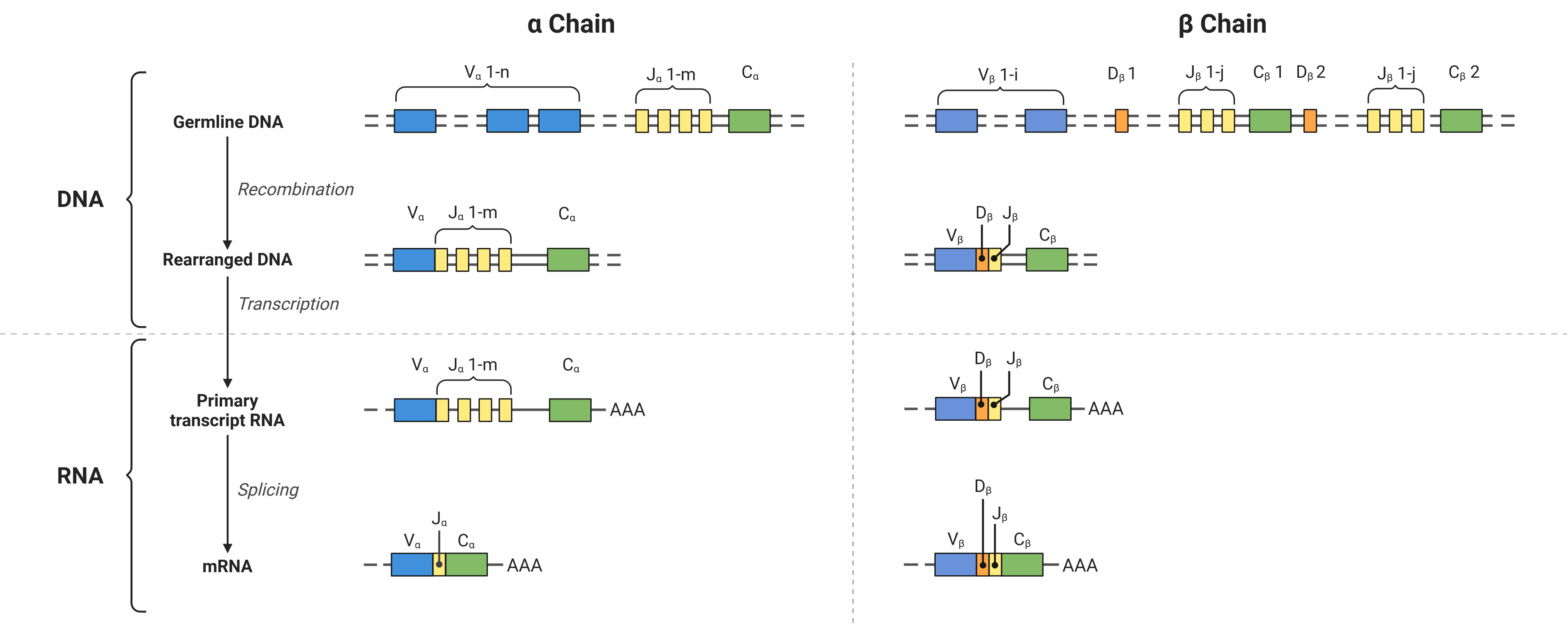
Figure 2:VDJ recombination at the example of an αβ-TCR. Created with BioRender.com.
Tools and databases report the CDR3 either as the junction, which includes the conserved cysteine and the phenylalanine or tryptophan that flank it, or without these residues.
The AIRR Rearrangement standard, which scirpy follows, stores both as separate fields, junction and cdr3, and sequences can only be compared between resources if they use the same definition Vander Heiden et al., 2018.
Sequencing immune receptors
Droplet-based protocols such as 10x Genomics 5’ sequencing amplify the receptor transcripts of each cell into a V(D)J library next to the gene expression library. Cell Ranger assembles these reads into contigs, annotates their gene segments and assigns them to cells. Receptors can also be reconstructed from gene expression reads alone, for which TRUST4 and MiXCR perform best, but only with sufficient sequencing depth and read length Song et al., 2021Bolotin et al., 2015Tian et al., 2025. For plate-based data with full-length transcripts, BraCeR and BALDR reconstruct mutated BCRs most accurately Andreani et al., 2022.
BCRs should additionally be re-annotated with IgBLAST against IMGT references, for example with Dandelion or the Immcantation suite, which also reconstructs the germline sequences needed to measure somatic hypermutation Suo et al., 2024Gupta et al., 2015.
Dataset
We use peripheral blood mononuclear cells (PBMCs) of the COVID-19 study by Stephenson et al., for which gene expression, TCR and BCR libraries were sequenced from the same cells with the 10x Genomics 5’ protocol Stephenson et al., 2021. We keep the 46 donors sampled in Cambridge, 11 healthy donors and 35 patients with asymptomatic to critical COVID-19, and the cell type annotation of the authors. The TCRs were assembled with Cell Ranger, and the BCRs were re-annotated with IgBLAST and their germline sequences reconstructed with Dandelion.
import warnings

import anndata as ad
import lamindb as ln
import scirpy as ir

warnings.filterwarnings("ignore", category=ad.ExperimentalFeatureWarning)

ln.connect("theislab/sc-best-practices")

ln.track("eZhjlUu0uDVY")
Output
→ connected lamindb: theislab/sc-best-practices
! It looks like you are running jupyter lab but don't have jupyter-server module installed. Please install it via pip install jupyter-server
→ loaded Transform('eZhjlUu0uDVY0000', key='ir_profiling.ipynb'), started new Run('AsSbEc6LOmD0yA5J') at 2026-09-29 18:06:28 UTC
→ notebook imports: anndata==0.13.2 lamindb-core==2.10.0 scirpy==0.25.1
The data are stored as a MuData object with the gene expression in the gex modality and the receptors in the airr modality, as introduced in the chapter on advanced data structures.
Cells without a detected receptor, such as monocytes, are only part of the gex modality.
mdata = ln.Artifact.get(key="air_repertoire/stephenson2021_cambridge.h5mu").load()
mdata
MuData object with n_obs × n_vars = 104492 × 24737
2 modalities
gex: 104492 × 24737
obs: 'patient_id', 'sample_id', 'sex', 'age', 'severity', 'days_from_onset', 'worst_clinical_status', 'outcome', 'cell_type_coarse', 'cell_type'
obsm: 'X_pca_harmony', 'X_umap'
layers: None
airr: 75188 × 0
uns: 'scirpy_version'
obsm: 'airr'Scirpy stores all contigs of a cell in the AIRR format.
index_chains keeps the productive chains and ranks them by their number of UMIs into a primary and a secondary VJ and VDJ chain, which we can retrieve with ir.get.airr.
ir.pp.index_chains(mdata)
ir.get.airr(
    mdata, ["locus", "junction_aa", "v_call"], ["VJ_1", "VDJ_1"]
).dropna().head()Quality control
A cell can express a second VJ or VDJ chain, since T cells often carry two α chains and B cells two light chains, whereas more than two chains of a type indicate doublets Schuldt & Binstadt, 2019Zhu et al., 2023.
chain_qc summarizes each cell by its receptor type and by the pairing of its chains:
single pair: one VJ and one VDJ chainorphan VJandorphan VDJ: only one of the two chainsextra VJ,extra VDJandtwo full chains: a second chain of one or both typesmultichain: more than two chains of a type, most likely doubletsambiguous: TCR and BCR chains in the same cell
ir.tl.chain_qc(mdata)
mdata.pull_obs()
The receptors detected in a cell should agree with its cell type, which the gene expression tells us.
_ = ir.pl.group_abundance(
    mdata,
    groupby="gex:cell_type_coarse",
    target_col="airr:receptor_type",
    normalize=True,
    figsize=(8, 4),
)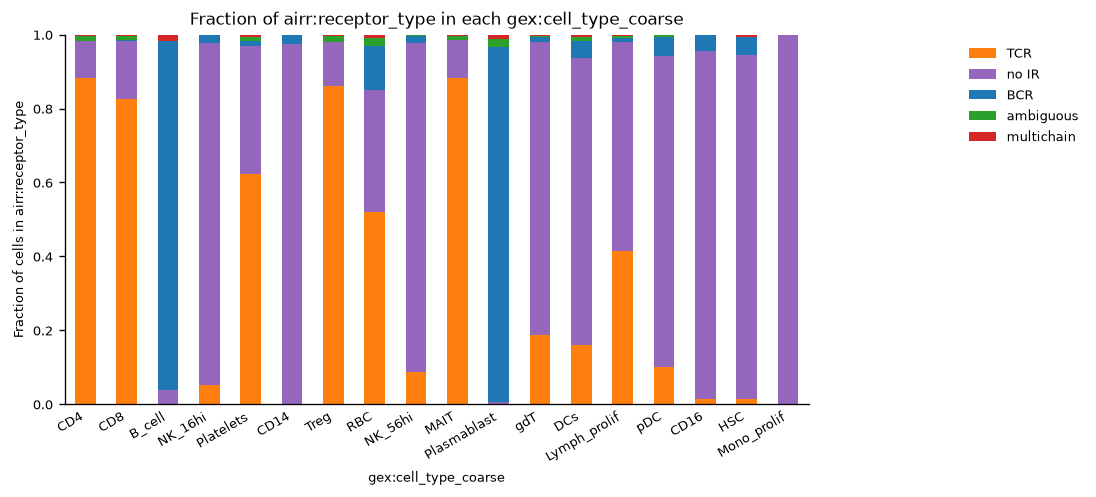
Most T cells and MAIT cells carry a TCR, and most B cells and plasmablasts a BCR. TCRs in NK cells or in cells annotated as platelets or red blood cells point to doublets, platelets bound to T cells or ambient RNA. γδ T cells rarely have a TCR, since the V(D)J library only amplifies αβ chains.
_ = ir.pl.group_abundance(
    mdata, groupby="airr:receptor_type", target_col="airr:chain_pairing", normalize=True
)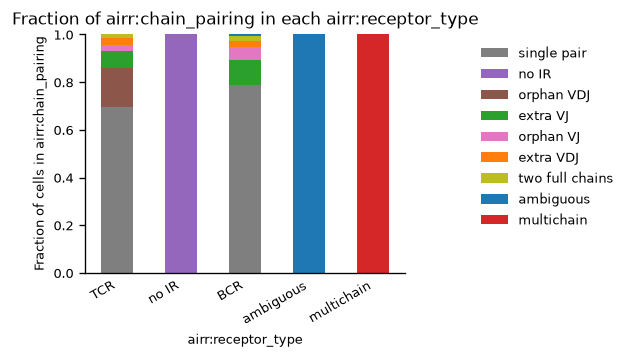
About 70% of T cells and 80% of B cells have a single pair of chains. Most of the remaining T cells lack the α chain, which is detected less often than the β chain, whereas B cells more often carry a second light chain.
Filtering
We remove cells with more chains than a cell can express and cells whose receptor does not match their cell type. We keep orphan chains and flag them, since whether they are usable depends on the analysis. Clonotypes defined by both chains cannot include them, whereas a database query of the β chain can. From here on, we analyze T and B cells separately, since their receptors are treated differently.
t_cells = ["CD4", "CD8", "Treg", "MAIT", "gdT", "Lymph_prolif"]
b_cells = ["B_cell", "Plasmablast"]
receptor_type = mdata.obs["airr:receptor_type"]
cell_type = mdata.obs["gex:cell_type_coarse"]
mdata_tcr = mdata[(receptor_type == "TCR") & cell_type.isin(t_cells)].copy()
mdata_bcr = mdata[(receptor_type == "BCR") & cell_type.isin(b_cells)].copy()
for data in (mdata_tcr, mdata_bcr):
    data.obs = data.obs.apply(
        lambda col: (
            col.cat.remove_unused_categories() if col.dtype == "category" else col
        )
    )
mdata_tcr.n_obs, mdata_bcr.n_obs
(54137, 13422)We store both objects for the clonotype analysis.
ln.Artifact.from_mudata(
    mdata_tcr,
    key="air_repertoire/stephenson2021_tcr_qc.h5mu",
    description="T cells with TCRs of the Stephenson 2021 Cambridge samples after quality control",
).save()
ln.Artifact.from_mudata(
    mdata_bcr,
    key="air_repertoire/stephenson2021_bcr_qc.h5mu",
    description="B cells with BCRs of the Stephenson 2021 Cambridge samples after quality control",
).save()
Output
→ creating new artifact version for key 'air_repertoire/stephenson2021_tcr_qc.h5mu' in storage 's3://lamin-eu-central-1/VPwcjx3CDAa2'
... uploading A54ugwVUlFz0PV5n0002.h5mu: 0.0%... uploading A54ugwVUlFz0PV5n0002.h5mu: 7.1%... uploading A54ugwVUlFz0PV5n0002.h5mu: 14.1%... uploading A54ugwVUlFz0PV5n0002.h5mu: 28.2%... uploading A54ugwVUlFz0PV5n0002.h5mu: 42.3%... uploading A54ugwVUlFz0PV5n0002.h5mu: 70.5%... uploading A54ugwVUlFz0PV5n0002.h5mu: 71.8%... uploading A54ugwVUlFz0PV5n0002.h5mu: 78.8%... uploading A54ugwVUlFz0PV5n0002.h5mu: 85.9%... uploading A54ugwVUlFz0PV5n0002.h5mu: 100.0%
• replacing the existing cache path /home/lheumos/.cache/lamindb/lamin-eu-central-1/VPwcjx3CDAa2/air_repertoire/stephenson2021_tcr_qc.h5mu
→ creating new artifact version for key 'air_repertoire/stephenson2021_bcr_qc.h5mu' in storage 's3://lamin-eu-central-1/VPwcjx3CDAa2'
... uploading ORrJ4xnxnhHL8smm0002.h5mu: 0.0%... uploading ORrJ4xnxnhHL8smm0002.h5mu: 14.0%... uploading ORrJ4xnxnhHL8smm0002.h5mu: 100.0%
• replacing the existing cache path /home/lheumos/.cache/lamindb/lamin-eu-central-1/VPwcjx3CDAa2/air_repertoire/stephenson2021_bcr_qc.h5mu
Artifact(uid='ORrJ4xnxnhHL8smm0002', key='air_repertoire/stephenson2021_bcr_qc.h5mu', description='B cells with BCRs of the Stephenson 2021 Cambridge samples after quality control', suffix='.h5mu', kind='dataset', otype='MuData', size=304891241, hash='c3Tz8USdyzyAKw5I5pv33h', n_files=None, n_observations=13422, extra_data=None, branch_id=1, created_on_id=1, space_id=1, storage_id=1, run_id=179, schema_id=None, created_by_id=2, created_at=2026-09-29 18:06:44 UTC, is_locked=False, version_tag=None, is_latest=True)Quiz
Contributors
We gratefully acknowledge the contributions of:
Authors
Felix Drost
Reviewers
Lukas Heumos
- Cooper, M. D., & Alder, M. N. (2006). The evolution of adaptive immune systems. Cell, 124(4), 815–822.
- Zarnitsyna, V., Evavold, B., Schoettle, L., Blattman, J., & Antia, R. (2013). Estimating the diversity, completeness, and cross-reactivity of the T cell repertoire. Frontiers in Immunology, 4, 485.
- Qi, Q., Liu, Y., Cheng, Y., Glanville, J., Zhang, D., Lee, J.-Y., Olshen, R. A., Weyand, C. M., Boyd, S. D., & Goronzy, J. J. (2014). Diversity and clonal selection in the human T-cell repertoire. Proceedings of the National Academy of Sciences, 111(36), 13139–13144. 10.1073/pnas.1409155111
- Vander Heiden, J. A., Marquez, S., Marthandan, N., Bukhari, S. A. C., Busse, C. E., Corrie, B., Hershberg, U., Kleinstein, S. H., Matsen IV, F. A., Ralph, D. K., Rosenfeld, A. M., Schramm, C. A., Community, T. A., Christley, S., & Laserson, U. (2018). AIRR Community Standardized Representations for Annotated Immune Repertoires. Frontiers in Immunology, 9, 2206. 10.3389/fimmu.2018.02206
- Song, L., Cohen, D., Ouyang, Z., Cao, Y., Hu, X., & Liu, X. S. (2021). TRUST4: immune repertoire reconstruction from bulk and single-cell RNA-seq data. Nature Methods, 18(6), 627–630. 10.1038/s41592-021-01142-2
- Bolotin, D. A., Poslavsky, S., Mitrophanov, I., Shugay, M., Mamedov, I. Z., Putintseva, E. V., & Chudakov, D. M. (2015). MiXCR: software for comprehensive adaptive immunity profiling. Nature Methods, 12(5), 380–381. 10.1038/nmeth.3364
- Tian, R., Yu, Z., Xue, Z., Wu, J., Wu, L., Cai, S., Gao, B., He, B., Zhao, Y., Yao, J., Lu, L., & Liu, W. (2025). Evaluation of T Cell Receptor Construction Methods from scRNA-Seq Data. Genomics, Proteomics & Bioinformatics, 22(6), qzae086. 10.1093/gpbjnl/qzae086
- Andreani, T., Slot, L. M., Gabillard, S., Strübing, C., Reimertz, C., Yaligara, V., Bakker, A. M., Olfati-Saber, R., Toes, R. E. M., Scherer, H. U., Augé, F., & Šimaitė, D. (2022). Benchmarking computational methods for B-cell receptor reconstruction from single-cell RNA-seq data. NAR Genomics and Bioinformatics, 4(3), lqac049. 10.1093/nargab/lqac049
- Suo, C., Polanski, K., Dann, E., Lindeboom, R. G. H., Vilarrasa-Blasi, R., Vento-Tormo, R., Haniffa, M., Meyer, K. B., Dratva, L. M., Tuong, Z. K., Clatworthy, M. R., & Teichmann, S. A. (2024). Dandelion uses the single-cell adaptive immune receptor repertoire to explore lymphocyte developmental origins. Nature Biotechnology, 42(1), 40–51. 10.1038/s41587-023-01734-7
- Gupta, N. T., Vander Heiden, J. A., Uduman, M., Gadala-Maria, D., Yaari, G., & Kleinstein, S. H. (2015). Change-O: a toolkit for analyzing large-scale B cell immunoglobulin repertoire sequencing data. Bioinformatics, 31(20), 3356–3358.
- Stephenson, E., Reynolds, G., Botting, R. A., Calero-Nieto, F. J., Morgan, M. D., Tuong, Z. K., Bach, K., Sungnak, W., Worlock, K. B., Yoshida, M., & others. (2021). Single-cell multi-omics analysis of the immune response in COVID-19. Nature Medicine, 27(5), 904–916.
- Schuldt, N. J., & Binstadt, B. A. (2019). Dual TCR T cells: identity crisis or multitaskers? The Journal of Immunology, 202(3), 637–644.
- Zhu, L., Peng, Q., Wu, Y., & Yao, X. (2023). scBCR-seq revealed a special and novel IG H&L V(D)J allelic inclusion rearrangement and the high proportion dual BCR expressing B cells. Cellular and Molecular Life Sciences, 80(11), 319. 10.1007/s00018-023-04973-8